
Article: How to Mic a Darbuka Without a Stand: Meet the U-750 Wireless Microphone
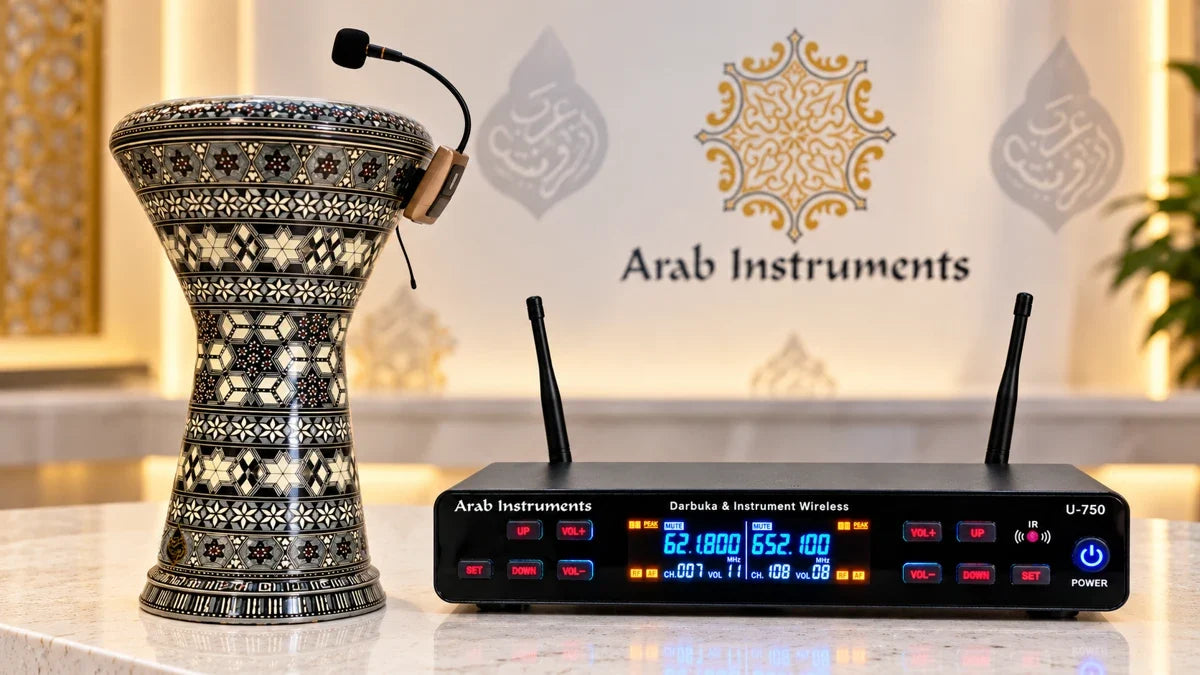
How to Mic a Darbuka Without a Stand: Meet the U-750 Wireless Microphone
No microphone stand. No separate bodypack. Just your darbuka, your music, and the freedom to perform.
If you've ever played darbuka on stage, you know the problem.
You want the audience to hear every deep DOOM, every sharp TAK, and every fast finger roll. But the microphone stand is always there, right in front of your drum.
Move too far, and the sound changes. Turn toward another musician, and suddenly you're no longer playing directly into the microphone.
We've spent years working with darbuka players, and we wanted to offer something more practical.
That's why we're introducing the Arab Instruments U-750 Wireless Microphone for Darbuka & Doumbek.
A compact wireless microphone system designed around the way darbuka players actually perform.

What Is the U-750 Wireless Darbuka Microphone?
The U-750 is a wireless microphone system for darbuka and doumbek drums, combining a compact instrument-mounted microphone and transmitter with a dual-channel UHF receiver.
Instead of placing a microphone on a stand in front of your drum, you attach the microphone directly to your darbuka.
The receiver connects to your mixer or PA system, allowing your performance to be amplified without a traditional microphone cable running from the drum.
The result is a simpler setup that lets you move naturally while playing.
EXPLORE THE U-750 MICROPHONE →
Why Is It So Difficult to Microphone a Darbuka?
A darbuka produces a surprisingly wide range of sounds.
Think about what happens during a typical performance.
One moment you're playing a deep, powerful DOOM. A fraction of a second later, you're producing sharp TAK strokes, quick finger rolls, and aggressive SLAP sounds.
A microphone needs to handle these different sounds, sometimes at very high volumes.
But sound quality is only half the challenge.
The other challenge is movement.
Unlike musicians who remain in one position, darbuka players often turn, move, interact with other performers, and play while standing.
A traditional microphone stand can make all of that more difficult.
The U-750 was developed to address these practical challenges.
No Microphone Stand. No Separate Bodypack.
This is one of the biggest differences between the U-750 and many traditional wireless instrument microphone setups.
With a conventional wireless microphone system, you may need to wear a transmitter bodypack, connect it to the microphone with a cable, and find somewhere to secure everything while playing.
The U-750 combines the microphone and wireless transmitter into one compact unit.
Here's how it works:
-
Attach the small mounting base to your darbuka.
-
Slide the wireless microphone unit into the mount.
-
Adjust the flexible microphone toward the drumhead.
-
Connect the receiver to your mixer or PA system.
-
Set your sound and start playing.
Once the mounting base is installed, you can easily attach or remove the microphone.
No separate bodypack to wear. No microphone stand in front of the instrument. No long microphone cable restricting your movement.
For live darbuka players, that's a meaningful difference.

Can a Wireless Microphone Handle Powerful DOOM and TAK Strokes?
This is one of the first questions darbuka players ask us.
And it's a good question.
Darbuka is not a quiet instrument, especially when played by an experienced percussionist.
The U-750 microphone is rated to handle sound pressure levels of up to 140 dB SPL.
That specification is particularly important when positioning a microphone close to a percussion instrument, where strong strokes can produce very high sound pressure.
The microphone is designed to capture the dynamics of darbuka playing, including:
-
Deep DOOM bass strokes
-
Sharp TAK attacks
-
Powerful SLAP strokes
-
Fast finger rolls and rhythmic patterns
However, there's something every musician should understand.
A microphone captures the sound of your darbuka. It doesn't create that sound.
And that brings us to an important point.
What Really Determines the Sound of Your Darbuka on Stage?
We want to be clear about this because it matters.
Buying a wireless microphone doesn't automatically guarantee perfect sound.
Your final amplified darbuka sound depends on several things.
1. The Darbuka You're Playing
Every darbuka has its own character.
The body construction, drumhead, tuning, and your playing technique all affect the sound.
Some darbukas produce a deeper DOOM. Others have a brighter TAK or a different balance between bass and treble.
Your microphone can capture those characteristics, but it cannot replace the natural quality of your instrument.
2. Your Mixer and Sound System
The mixer, speakers, amplifier, and other audio equipment all influence what your audience hears.
A well-designed sound system with appropriate settings can make a significant difference.
3. The Experience of Your DJ or Sound Engineer
This is often overlooked.
A sound engineer who understands darbuka can make a major difference through proper gain, EQ, compression, and volume adjustments.
Our advice?
Spend time on your soundcheck.
Listen to your DOOM, TAK, and SLAP strokes individually. Adjust the sound for your particular drum and venue.
The U-750 gives you the wireless connection and practical setup. The final sound still depends on the entire audio system.

Wireless Darbuka Microphone vs. Traditional Wired Microphone
Which is better?
That depends on how and where you play.
A high-end professional wired microphone setup can offer greater audio fidelity, particularly for demanding studio recording applications.
But live performances involve more than recording quality.
They involve movement, comfort, quick setup, and interaction with your audience.
Here's how the two approaches compare:
| Feature | Traditional Wired Microphone | U-750 Wireless System |
|---|---|---|
| Microphone stand | Often required | Not required |
| Cable from drum to mixer | Usually required | Not required |
| Separate bodypack | Not applicable for a standard wired mic | Not required |
| Freedom of movement | More limited | Greater |
| Studio recording | High-end options available | Primarily designed for live performance |
| Setup | Depends on mic and mounting arrangement | Compact instrument-mounted setup |
The U-750 isn't intended to replace every professional microphone in every situation.
It's designed for musicians who want good amplified darbuka sound together with greater freedom and convenience on stage.
Can You Connect Two Darbukas to the Same Wireless Receiver?
Yes, with two compatible wireless transmitters.
The U-750 features a dual-channel wireless receiver, allowing two compatible microphones to operate simultaneously.
For example, you could use the system with two darbuka players performing together.
Or you could connect one compatible microphone to a darbuka and another to a different acoustic instrument.
The receiver offers two ways to connect to your mixer.
MIX OUT: One Mixer Channel
The MIX OUT connection combines the sound from both wireless channels into one output.
This can be convenient when you want a simple connection to your sound system.
Separate XLR Outputs: Independent Sound Control
The receiver also provides separate balanced outputs for Channel A and Channel B.
Connect each output to a different mixer channel, and your sound engineer can adjust each instrument independently.
That means separate EQ, gain, compression, and volume settings.
This can be particularly useful when two instruments have very different sound characteristics.
Please note: The standard U-750 set includes one wireless microphone transmitter. Using two instruments simultaneously requires a second compatible transmitter.

Is the U-750 Only for Darbuka and Doumbek?
Darbuka and doumbek players were the main focus of this project.
However, the microphone system can also be suitable for other percussion and acoustic instruments, provided the mounting system and microphone characteristics are appropriate.
That makes it an option worth considering for musicians who perform with more than one instrument.
What UHF Frequencies Does the U-750 Use?
The international U-750 system operates within the 510–590 MHz UHF frequency range.
Wireless microphone regulations vary by country, and not every frequency is permitted in every location.
Before purchasing, check which frequencies are legally available for wireless microphone use in your country and region.
Customers should verify local frequency permissions before operating the system. Applicable product compliance requirements must also be met.

Who Should Consider the U-750 Wireless Darbuka Microphone?
We developed this system with live performers in mind.
It may be particularly useful if you:
-
Play darbuka or doumbek at weddings, concerts, clubs, or private events.
-
Want to move more freely during performances.
-
Prefer not to have a microphone stand positioned in front of your drum.
-
Don't want to wear a separate wireless transmitter bodypack.
-
Perform with another percussionist and want a dual-channel receiver.
-
Want a compact microphone setup for live performance.
Developed by Arab Instruments — Specialists in Arabic Musical Instruments Since 2009
At Arab Instruments, darbuka isn't just another product category.
We've specialized in Arabic and Middle Eastern musical instruments since 2009, working with instrument makers, musicians, and darbuka players around the world.
Over the years, we've seen how different players perform, what equipment they use, and the practical challenges they face.
The U-750 is our attempt to offer a wireless microphone solution developed around those needs.
Not simply another microphone placed in front of a drum.
A microphone system that moves with the instrument.
Frequently Asked Questions About Darbuka Microphones
What is the best way to mic a darbuka for live performance?
A common approach is to position a microphone near the drumhead using a stand or instrument mount. The best placement depends on the microphone, the instrument, and the desired sound. An instrument-mounted wireless microphone such as the U-750 offers an alternative for players who want greater mobility without a traditional stand.
Can you use a wireless microphone with a doumbek?
Yes. The U-750 is designed for darbuka and doumbek, two names commonly used for closely related Middle Eastern goblet drums.
Does the U-750 require a microphone stand?
No. The microphone attaches directly to the instrument using its mounting system.
Do I need to wear a wireless bodypack?
No. The U-750 combines the microphone and wireless transmitter in one compact instrument-mounted unit.
Does the U-750 connect to a professional mixer?
Yes. The receiver provides connections for compatible mixers and PA systems, including separate balanced XLR outputs and a combined MIX OUT connection.
Can I use two microphones at once?
The receiver supports two compatible wireless transmitters simultaneously. A second compatible transmitter is required if you want to microphone two instruments at the same time.
Will the U-750 make my darbuka sound better?
The U-750 captures and transmits your instrument's sound. The final result depends on the darbuka, its tuning, the sound system, and the settings used by your DJ or sound engineer.
Is the U-750 suitable for studio recording?
The system is primarily intended for convenient wireless live performance. For critical studio recording, a high-end wired microphone setup may provide greater audio fidelity.
A New Way to Perform with Your Darbuka
When you're performing, you want to concentrate on your rhythm, your technique, and your connection with the audience.
Not on staying in front of a microphone stand.
That's the idea behind the Arab Instruments U-750 Wireless Microphone for Darbuka & Doumbek.
Attach the microphone. Connect the receiver. Set your sound.
And play.
VIEW THE U-750 WIRELESS DARBUKA MICROPHONE & PRE-ORDER YOURS
The U-750 package includes the wireless microphone system, not the darbuka drums shown in demonstration images.

Read more

What So Special About Plastic Ney Flute?
Professional Plastic Ney Flute — Durable, Tuned & Ready to Play The evolution of traditional musical instruments never stops. Arab Instruments is proud to present the professional Plastic ne...
Read more